



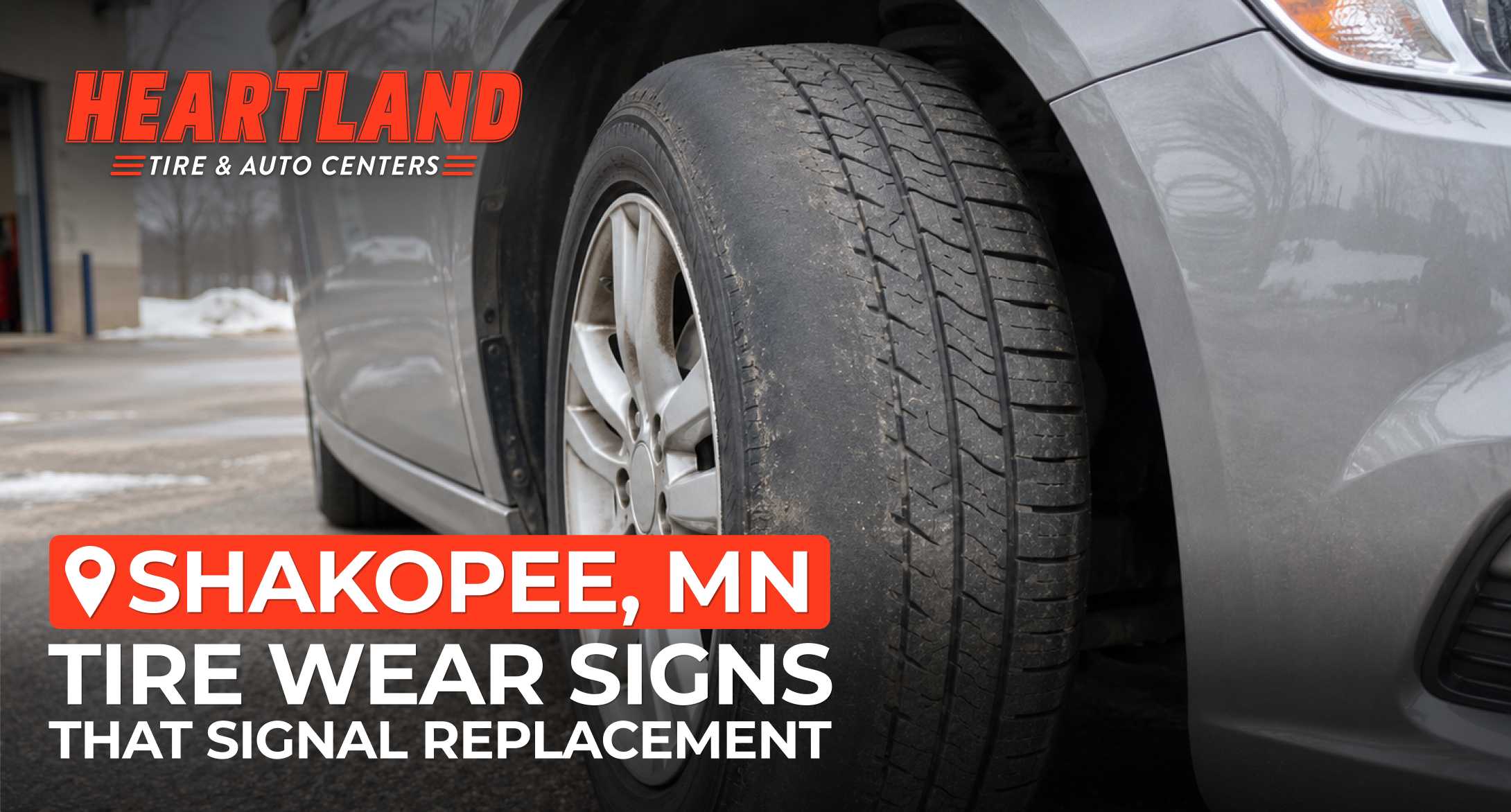
If you know the Shakopee MN tire wear signs to watch for, you can catch tire problems before they become a safety issue or leave you stranded. Uneven tread, worn-down grooves, sidewall cracks, vibrations, and changes in handling can all tell you something about your tires and the vehicle underneath them.
For drivers in Shakopee, regular tire checks are especially useful. Potholes, temperature changes, wet roads, winter conditions, and everyday stop-and-go driving can all affect tire condition. Knowing what you see and feel can help you decide when to schedule service and when it is time for a new set.
TL;DR – Shakopee MN Tire Wear Signs to Know
- Check tread depth – Tires at or below 2/32 inch have reached the minimum tread depth and should be replaced. Some tire professionals recommend planning a replacement earlier, especially when wet-weather performance starts to decline.
- Look for uneven wear – Wear on one edge, the center, or alternating sections of the tread can point to pressure, alignment, balancing, suspension, or rotation problems.
- Inspect for visible damage – Cracks, cuts, bulges, blisters, or exposed cords require prompt professional attention and may mean the tire needs replacement.
- Pay attention to driving changes – Vibration, pulling, poor wet traction, or unusual road noise can indicate tire wear or another problem affecting the wheels, steering, or suspension.
- Consider tire age – Tread condition matters, but rubber also ages. Michelin recommends annual professional inspections after five years and replacement at 10 years from manufacture as a precaution.
What Are the Most Common Shakopee MN Tire Wear Signs?
Tires usually give you several clues before they become completely worn out. Some are easy to see during a driveway inspection, while others become noticeable only when you drive.
The most useful approach is to inspect the tread and sidewalls while also paying attention to how the vehicle feels on the road. If something looks or feels different from normal, it is worth having the tires checked.
1. Low tread depth
Tread depth is one of the clearest measurements of tire condition. The grooves in the tread help channel water away from the contact patch and provide traction during braking, acceleration, and cornering.
A tread depth gauge provides the most accurate reading. The legal minimum is generally 2/32 inch, and tires at that level should be replaced. AAA notes that 4/32 to 5/32 inches can be a useful planning point, as traction and wet-weather performance can decline before the legal minimum is reached.
2. Wear bars sitting flush with the tread
Look inside the main grooves of your tires for small raised bars. These are built-in treadwear indicators.
When the surrounding tread wears down to be level with those bars, the tire has approximately 2/32 inch of remaining tread. That is a clear signal to replace it.
3. Uneven tread patterns
Your tires should generally wear relatively evenly across the tread. If one section looks significantly different from another, the pattern can provide clues about what is happening.
Center wear can indicate overinflation, while wear along both shoulders can indicate underinflation. One-sided wear may point toward alignment or suspension problems.
4. Cracks, cuts, or bulges
The sidewall deserves as much attention as the tread. Look for deep cuts, cracking, bulges, bubbles, or other changes in the rubber.
A bulge can indicate internal structural damage. Michelin advises having visible sidewall damage inspected immediately, and damage such as a bulge may require replacement.
5. Vibration or changes in handling
A new vibration through the steering wheel, seat, or floor can indicate a tire, wheel balance, alignment, or suspension problem.
Do not assume vibration is something you simply have to live with. Finding the cause early can prevent additional tire wear and may help identify a developing mechanical problem.
These signs can overlap, so a professional inspection can be valuable when you are unsure what you are seeing. A tire that appears acceptable from the outside may still have an internal problem.
Real Savings
Heartland Values
Claim Yours and Book
An Appointment

How Do Different Tire Wear Patterns Develop?
Understanding tire wear patterns can help you connect what you see to the underlying problem. The pattern itself does not always provide a final diagnosis, but it gives a technician an important starting point.
Center tread wear
If the center of the tread wears faster than the shoulders, the tire pressure may be too high for the vehicle’s recommended setting.
Always use the pressure listed on the vehicle’s door-jamb label or owner’s manual rather than the maximum pressure printed on the tire sidewall.
Shoulder wear
Excessive wear on both outside shoulders can occur when a tire is underinflated. An underinflated tire flexes more and can place additional wear on the edges.
Regular pressure checks are particularly helpful when temperatures change, as tire pressure can vary with air temperature.
One-sided wear
When the inner or outer edge wears considerably faster than the rest of the tread, alignment or suspension issues may be involved.
This is one reason uneven tire wear in Shakopee should be investigated instead of simply replacing the tires and moving on. If the underlying cause remains, a replacement set can develop the same pattern.
Cupping or scalloping
Cupping creates a series of uneven high and low spots around the tread. It can be associated with wheel balance issues, worn shocks or struts, or other suspension conditions.
This type of wear can produce a repeating humming or thumping sensation. An inspection can determine whether the tire is the source or whether another component needs attention.
Feathered tread
Run your hand lightly across the tread when the vehicle is parked, and the tires are cool. If the tread blocks feel smooth in one direction but noticeably sharper in the other, feathering may be present.
Alignment problems are one possible cause. Correcting the underlying condition can help protect the remaining tread.
Different wear patterns can occur simultaneously. For example, a vehicle may have alignment-related edge wear combined with pressure-related wear, which is why measuring tread across several points is more useful than checking one spot.
When Should You Replace Tires in Shakopee?
There is no single mileage number that tells every driver when to replace their tires. Tire life depends on tire construction, driving habits, inflation, road conditions, alignment, vehicle weight, climate, and maintenance.
Instead, look at several factors together.
Tread depth reaches the replacement point
At 2/32 inch, the tread has reached the commonly recognized minimum. Built-in wear indicators can help you identify this condition without special equipment.
For drivers who regularly encounter rain or prepare for Minnesota winter driving, planning ahead based on remaining tread can make sense. You do not want to discover that your tires are marginal when the weather has already changed.
Damage compromises the tire
A tire with a serious sidewall cut, bulge, exposed cords, or other structural damage may require immediate replacement regardless of remaining tread.
Road hazards can cause damage that is unrelated to normal tread wear. AAA specifically identifies potholes, rocks, and debris as hazards that can damage tires and lead to earlier replacement.
The tire has aged significantly
Check the DOT code on the sidewall to determine the tire’s manufacturing date. The final four digits indicate the week and year of manufacture.
Michelin recommends increased annual inspection after five years of service and recommends replacing tires at 10 years from the date of manufacture as a precaution, regardless of remaining tread.
Performance has changed
If your vehicle takes longer to stop, feels less stable, loses wet-road grip, or develops persistent vibration, have the tires inspected.
Performance changes can sometimes point to tire aging or wear even when the tread does not look especially bad.
When comparing tire replacement options in Shakopee, focus on the condition of all four tires rather than automatically replacing one. Tire size, tread depth, vehicle drivetrain, and manufacturer recommendations all matter when deciding whether to replace one, two, or four tires.
How Can You Check Your Tires at Home?
You do not need a garage full of equipment to perform a basic tire check. A few minutes once a month can help you notice changes before they become bigger problems.
Start with the vehicle parked on a level surface and the tires cool. Then inspect each tire rather than checking only the one that looks most worn.
Use this quick inspection routine
- Check the tread – Look across the full width of each tire. Compare the inside, center, and outside portions for differences in wear.
- Check the wear indicators – Find the raised bars inside the main grooves. If the tread is level with them, the tire has reached its minimum tread depth.
- Measure tread depth – A tread depth gauge gives you a more precise reading than a visual inspection. Measure several locations on each tire.
- Inspect the sidewalls – Look for cuts, cracks, bulges, bubbles, or other damage.
- Check tire pressure – Use a reliable gauge and compare the reading with the vehicle manufacturer’s recommended pressure.
- Look for foreign objects – Nails, screws, glass, and other debris can cause slow leaks or sudden pressure loss.
- Notice changes while driving – Pay attention to pulling, vibration, unusual noise, or changes in steering response.
A monthly inspection is a simple habit, but it becomes even more useful before a long trip or when seasons change. If you spot something unusual, a professional tire inspection in Shakopee can help determine whether the issue is normal wear, damage, or a symptom of another vehicle problem.
Shakopee MN Tire Wear Signs and Heartland Tire & Auto Centers
Recognizing Shakopee MN tire wear signs gives you an advantage as a vehicle owner. Low tread, uneven wear, sidewall damage, vibration, pulling, and changes in traction all deserve attention. Catching these signs early can help protect your tires and identify alignment, pressure, balance, or suspension problems before they become more expensive.
For drivers looking for tire replacement in Shakopee, the goal should be to choose the right tires based on the vehicle, driving conditions, and remaining tread on the existing set. Heartland Tire & Auto Centers provides tire services and auto repair at its Shakopee location, with experienced technicians available to help evaluate tire condition and recommend the appropriate next step.
If you have noticed unusual tread wear, a vibration, a tire that keeps losing air, or visible damage, consider having it checked before the problem grows. Heartland Tire & Auto Centers’ Shakopee location provides tire inspection, tire repair and installation, rotation, balancing, and wheel alignment in Shakopee.
You can request an appointment online through Heartland Tire & Auto Centers and have your tires evaluated by a local team that understands Minnesota drivers’ needs.